
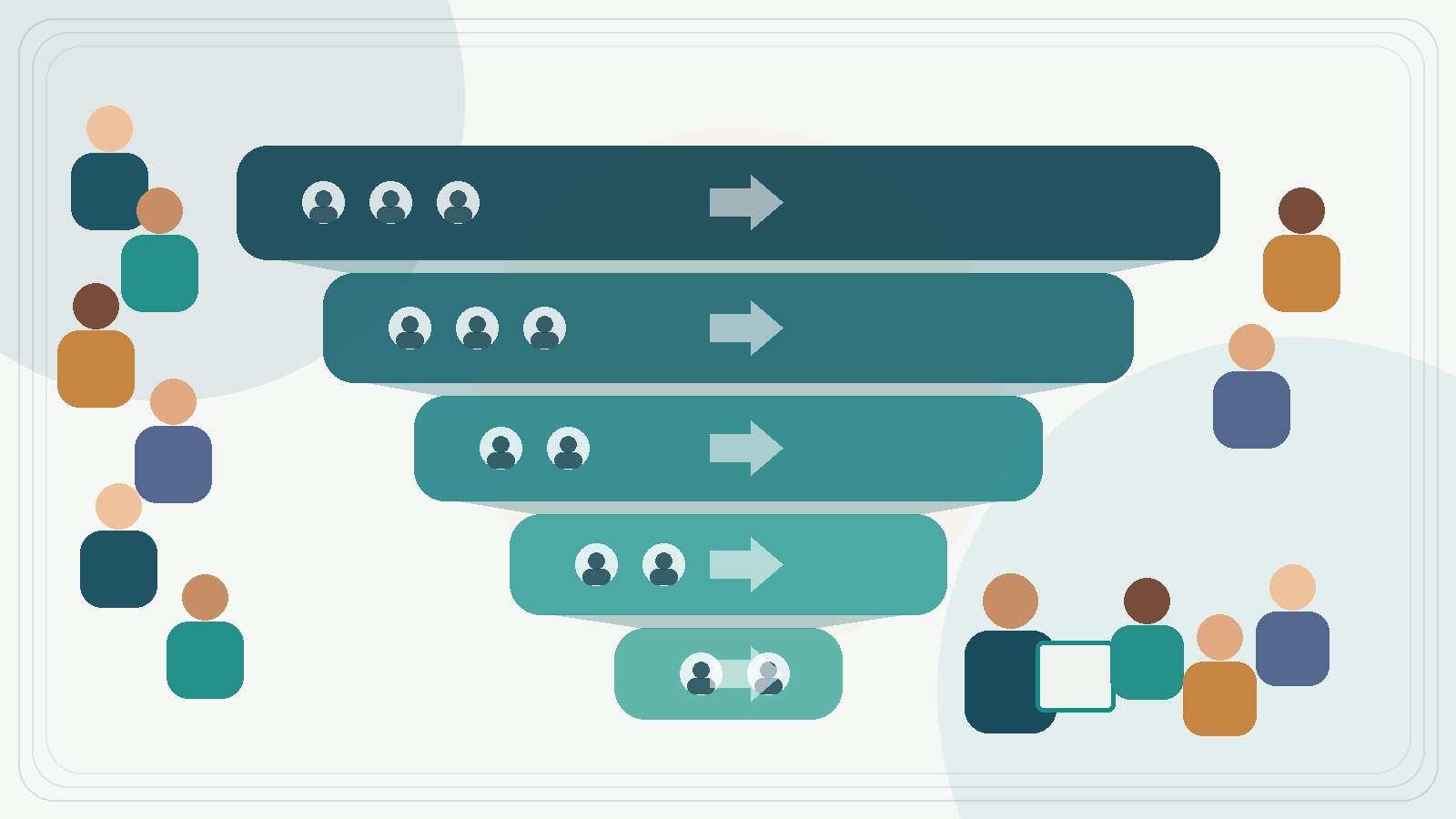
Your clinic may see 5,000 patients a year. That does not mean your investigator-initiated trial can enroll 100 of them.
Total patient volume is the widest point of a recruitment funnel. Every protocol criterion, competing study, scheduling constraint, consent decision, and follow-up burden narrows it. If you skip those conversions, you do not have a recruitment forecast. You have an optimistic denominator.
A useful IIT recruitment feasibility funnel converts the population into six measurable stages: potentially relevant, protocol-eligible, identifiable and ethically approachable, interested, consented and enrolled, and retained through the required endpoint. The purpose is not to manufacture certainty. It is to expose assumptions before they become missed timelines.
Recruitment feasibility is more than a patient count
ICH E6(R3) states that an investigator should be able to demonstrate—using retrospective or currently available data, for example—the potential to recruit the proposed number of eligible participants within the agreed recruitment period. It also connects feasibility to sufficient time, qualified staff, and adequate facilities (ICH E6(R3), §§2.2.1–2.2.2).
That is stronger than asking, “How many patients with this diagnosis do we see?” A credible forecast asks how many meet every material criterion, can be approached under the approved pathway, will accept the burden, can be screened by the team, and must remain through the primary endpoint.
The study design and sample-size calculation define what the study needs. The feasibility funnel tests whether your clinic can supply it.
Build the funnel in six stages
1. Potentially relevant population
Start with a defined period and reproducible source: appointment records, diagnostic codes, procedure logs, disease registries, or another permitted source.
Do not start with memory. “We see these patients all the time” cannot be audited and ignores repeat visits. Count unique people, not encounters, unless encounters are genuinely the required unit.
Record the source, extraction date, lookback period, and limitations. A code may be broad. A diagnosis may be missing. Referral volume may be seasonal. Qualify the estimate rather than hiding uncertainty.
2. Protocol-eligible population
Apply proposed inclusion and exclusion criteria in sequence. Separate criteria testable from existing data from those requiring screening or clinical judgment.
A common diagnosis can become a small eligible population after age, severity, prior treatment, medication, washout, comorbidity, imaging, and visit-window requirements are applied.
Test whether each criterion is scientifically necessary. In Canada, TCPS 2 Article 4.1 links fair inclusion to research-relevant selection and says people should not be excluded on listed attributes without a valid reason (TCPS 2, Chapter 4). Other jurisdictions have their own requirements. Unjustified exclusions damage feasibility and representativeness.
3. Identifiable and ethically approachable population
Eligibility does not automatically authorize contact.
Define how potential participants may be identified and approached under applicable privacy rules, ethics approval, policy, and the clinical relationship. For FDA-regulated research, FDA says the IRB should review proposed recruitment methods and materials. ICH E6(R3) identifies recruitment procedures among materials requiring documented IRB/IEC approval or favourable opinion before initiation (FDA; ICH E6(R3), §2.4.2).
Do not use feasibility work to begin unapproved outreach. Count what can be counted lawfully, document unresolved assumptions, and route the plan through the applicable review process.
4. Interested and screenable population
Now account for participant burden and site capacity.
An eligible person may reject extra visits, travel, time away from work, treatment uncertainty, washout, imaging, questionnaires, or follow-up. NIMH recommends identifying barriers, using prior local studies where available, matching tools to the audience, and piloting recruitment and screening. It explicitly says its resource is not a cookbook that assures success (NIMH).
The team is another conversion limit. Estimate how many calls, prescreens, consent discussions, clinic screens, and follow-up contacts one trained coordinator can complete each week. A large pool cannot compensate for a one-person bottleneck.
5. Consented and enrolled population
Keep interest, consent, and enrollment separate. An interested person may decline after learning the requirements. A person who signs consent may fail screening. An eligible person may not begin because of a new finding or scheduling failure.
Track each loss with a defined reason. This improves the next forecast and may reveal a design problem. It does not justify pressuring people through consent. Voluntary informed consent is participant protection, not a conversion target. See the Sengi informed-consent guide.
6. Retained and analysable population
Enrollment is not the end. The study needs enough participants to complete the visits and assessments required for the prespecified analysis.
Forecast retention by visit and through the primary endpoint. Consider visit burden, duration, seasonal availability, travel, coordinator continuity, and rescheduling. NIMH recommends planning retention alongside recruitment, monitoring it, and using local data where possible.
If your target is 60 analysable participants, a forecast of 60 enrolled participants works only when loss before the endpoint is expected to be zero. That assumption deserves scrutiny.
Turn the funnel into an assumption ledger
| Funnel stage | Starting number | Conversion | Evidence | Result | Owner | Update trigger |
|---|---|---|---|---|---|---|
| Potentially relevant | 1,200 | — | Unique clinic records, prior 12 months | 1,200 | Data lead | Quarterly extract |
| Protocol-eligible | 1,200 | 20% | Sample chart review | 240 | Investigator | Protocol change |
| Approachable | 240 | 75% | Approved pathway and contact data | 180 | Coordinator | Ethics decision |
| Interested/screened | 180 | 50% | Pilot calls and prior clinic study | 90 | Coordinator | First 20 contacts |
| Enrolled | 90 | 70% | Expected in-person screen failures | 63 | Investigator | First 10 screens |
| Retained to endpoint | 63 | 85% | Comparable follow-up data | 54 | Coordinator | Monthly review |
These are illustrative numbers, not benchmarks. Replace each percentage with local evidence or label it as an assumption. If one person supplies every optimistic rate, ask someone independent to challenge the chain.
Run three scenarios: a base case using best-supported assumptions; a conservative case with plausible lower conversions; and a failure case for the stage most likely to break. A proposal that works only in the optimistic case is not ready.
IIT control changes who must solve the gap
In an industry-sponsored trial, the sponsor usually defines the protocol and recruitment period. A participating site estimates whether it can deliver its share and should challenge unsupported assumptions.
In an IIT, the investigator or institution may control the question, criteria, visit schedule, and operating model while also holding sponsor responsibilities. That creates room to repair feasibility—but also responsibility. The investigator may not personally be the legal sponsor. Confirm the allocation rather than inferring it from “IIT”; the responsibility guide explains the distinction.
A gap may support simplifying nonessential criteria, reducing avoidable burden, extending the period, adding qualified sites, improving coordinator capacity, piloting recruitment, revising the design, or stopping before launch. Do not remove a scientifically necessary criterion merely to recruit faster. Do not turn an operational problem into an ethical compromise.
The strongest limitation: a funnel can still be wrong
Historical data may not reflect the final protocol. Coding may overcount. A competing trial may open. Approval delays may shift the season. Early participants may reveal underestimated burden.
Keep the funnel as an assumption ledger. Predefine comparisons after the first 20 contacts, first 10 screens, and monthly, for example. Record actual conversion and revise timelines or resources before the shortfall becomes unrecoverable.
The objective is not perfect prediction. It is visible, testable, owned uncertainty.
Decide whether the IIT is ready to enroll
Before committing to a target, require: a reproducible population count; a criterion-by-criterion eligibility estimate; an ethics- and privacy-compatible approach pathway; and a capacity and retention forecast that works under a conservative scenario.
This is the “Enroll with Confidence” stage of Sengi’s proprietary LENS framework. The broader method is described in Eye-Dea to Impact.
If your funnel has an unsupported conversion, no owner, or no update trigger, fix that before promising a timeline.
Take the next step
A credible recruitment forecast should expose the assumptions that control whether your IIT can enroll and retain enough participants. Explore the full LENS framework in Eye-Dea to Impact, or discuss how Sengi can help turn your research question into a workable IIT operating plan.